Published July 22, 2026 · Updated October 7, 2026 · 5 min read
Best Flooring for a Basement in Lebanon County, PA: Vinyl Plank, Tile, Carpet or Concrete, and the Moisture Test First (2026)
By the Amazing Builders crew, Myerstown, PA. Prices quoted are typical ranges for our region, not a quote for your house. Ask for one.
A basement floor is a concrete slab sitting on Lebanon County clay, and clay holds water. Whatever you put on that slab has to live with moisture coming up through it, humidity in the summer, and the occasional puddle from a water heater or a washing machine. That rules out solid hardwood and most laminate, and it is why the answer to "what is the best basement floor" is usually vinyl plank, with porcelain tile a close second where water is likely and carpet a good choice only after the slab passes a test.
Typical regional costs, not a quote.
Basement flooring cost, installed
| Floor | Per square foot | Notes |
|---|---|---|
| Luxury vinyl plank | $4 to $9 | Waterproof, floating, warm, the usual pick |
| Engineered vinyl tile | $4 to $10 | Same material in a tile look |
| Porcelain or ceramic tile | $7 to $15 | Permanent, waterproof, cold; best with a laundry or bath |
| Sealed or stained concrete | $3 to $8 | Industrial look, cheapest, hard and cold |
| Carpet with pad | $3 to $7 | Warmest; only over a slab that tested dry |
| Moisture testing and vapor barrier | $1 to $3 extra, or a flat fee | Done before any of the above |
For an 800-square-foot basement, vinyl plank alone runs about $3,200 to $7,200. The rest of the basement budget is in our basement finishing cost guide.
 Warwick Township (Lititz), PASep 2025during
Step one: the moisture test
Before a floor is chosen, we test the slab. The simple version: tape a two-foot square of plastic sheeting to the concrete, seal all four edges, and leave it for 48 to 72 hours. Dark concrete or condensation under it means moisture is coming up. A calcium chloride test gives a number when the result is borderline.
A slab that passes can take any floor on this page. A slab that fails can still take vinyl plank or tile, with a vapor barrier under it, but never carpet or anything with a wood core. A slab that is actually wet, with standing water or efflorescence on the walls, needs a waterproofing fix before any floor; the EPA's guide to mold and moisture explains why finishing over it is a bad idea.
Vinyl plank: the usual answer
Luxury vinyl plank is waterproof through its full thickness, floats over the slab without glue, feels warmer than tile, and looks like wood from standing height. If the basement floods, the planks can be lifted, dried and relaid. For a family room, an office or a playroom, it is the floor we recommend first.
What to specify:
- A rigid-core plank (often sold as SPC) rather than a flexible one. It bridges small slab imperfections and does not dent under furniture.
- An attached underlayment, or a separate vapor-barrier underlayment on a borderline slab.
- A quarter-inch expansion gap at every wall, hidden by trim. Basement temperature swings move a floating floor more than upstairs.
What it does not like: a slab with a hump or a dip of more than an eighth of an inch over six feet. We level those first.
Porcelain tile: for the wet jobs
Tile is the floor that does not care. It is the right choice when the basement has a laundry, a bathroom, a utility sink or a history of water on the floor. In Warwick Township near Lititz we laid marble-look porcelain across a basement with new plumbing lines for a future bath; the owner will never worry about that floor. The light tile also reflects what daylight a basement gets.
The trade-offs are cost and cold. Tile needs a flat slab or a leveling layer, a crack-isolation membrane over any slab cracks, and it is cold underfoot. A rug in the sitting area solves that for far less than a heated floor, though an electric heating mat under tile is an option at $8 to $15 per square foot more.
 Warwick Township (Lititz), PASep 2025during
Carpet: the warm option with one condition
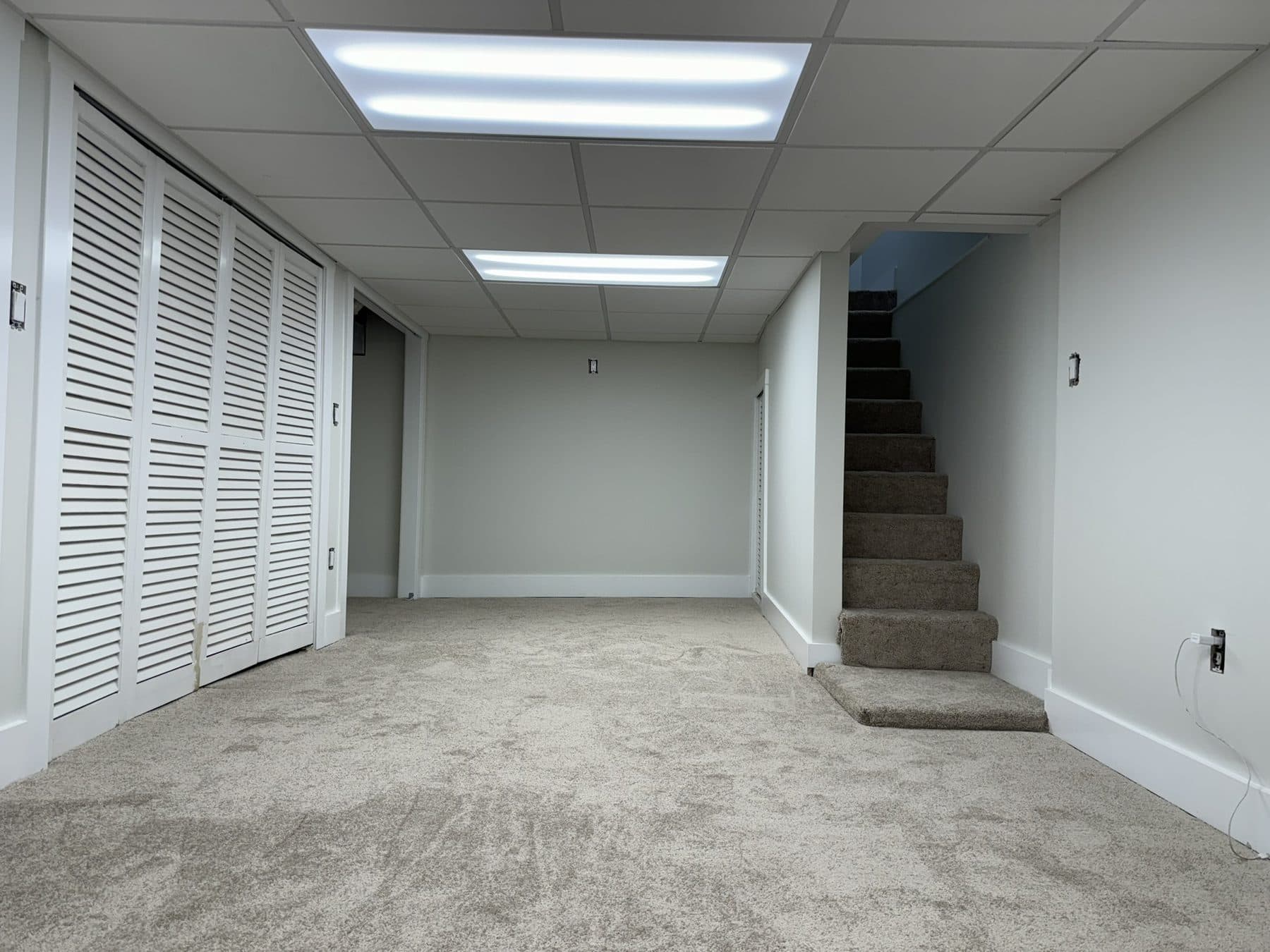
Carpet with a good pad is the warmest and quietest basement floor and the one kids prefer. In a South Philadelphia rowhome we carpeted a finished basement over a slab that had passed its moisture test. The condition is in that sentence. Carpet over a damp slab grows mold in the pad within a season. If the test is clean, use a synthetic carpet and a moisture-resistant pad. If it is not, choose vinyl plank.
Sealed or stained concrete: honest and cheap
Grinding and sealing the slab, or staining it, gives a finished floor for $3 to $8 per square foot. It is hard, cold and loud, and it suits a workshop, a gym or a modern basement with area rugs. It is also the floor that is easiest to change later.
Floors that do not belong in a basement
- Solid hardwood. Wood on concrete cups and gaps with the seasons. There is no installation method that makes it reliable below grade.
- Standard laminate. The fiberboard core swells with moisture. Some "waterproof" laminates exist; vinyl plank does the same job better.
- Glue-down anything on a slab that has not been tested. Moisture lifts glue.
Installation notes for Lebanon County basements
- Older houses in Lebanon, Annville and Myerstown have slabs poured in sections, with cracks at the joints. Vinyl plank floats over them; tile needs a membrane across them.
- Stone-foundation farmhouses often have uneven or partially unfinished slabs. A leveling layer is part of the floor cost.
- Sump pumps and floor drains stay accessible. We cut the floor around them cleanly rather than covering them.
- The stairs get their own treatment: carpet for warmth or wood treads to match the main floor. Vinyl plank on stairs needs special nosings.
 South Philadelphia, PAAug 2025after
Frequently asked questions
What is the best flooring for a basement in Lebanon County? Vinyl plank for most basements. Porcelain tile where there is a laundry or bathroom. Carpet only over a slab that tested dry.
How much does basement flooring cost? $4 to $15 per square foot installed depending on material, plus $1 to $3 for moisture testing and a vapor barrier where needed.
Can I put vinyl plank over a damp slab? Over a slab with some vapor, yes, with a vapor-barrier underlayment. Over a slab with standing water, no floor goes down until the water is handled.
Do I need a subfloor in a basement? Not for vinyl plank or tile. A raised subfloor system adds warmth and a gap for air under carpet, at about $2 to $4 per square foot more.
Get a number for your basement floor
Our basement finishing page and flooring page cover the rest. Send the rough size and tell us what the basement is for, and we will do the moisture test before we recommend anything.