Published October 17, 2026 · 7 min read
Stair Railing Height and Code in Pennsylvania: Handrails, Guards and Baluster Spacing (2026)
By the Amazing Builders crew, Myerstown, PA. Prices quoted are typical ranges for our region, not a quote for your house. Ask for one.
A stair handrail in a Pennsylvania house has to sit between 34 and 38 inches above the stair, measured straight up from the front edge of the treads. A railing that protects an open side, called a guard, has to be at least 36 inches high on a landing or loft and at least 34 inches along the stair itself. No opening in it can let a 4-inch ball pass through. Those are the numbers an inspector in Lebanon or Lancaster County checks, and the rest of this page explains where they come from and how they apply to an older house.
This is a plain-language summary for homeowners, not legal advice. Your township's code official has the final word, and we call them before any stair job that needs a permit.
Which code applies in Pennsylvania
Pennsylvania uses one statewide building code, the Uniform Construction Code (UCC). For houses, the UCC adopts the International Residential Code (IRC) with state amendments. On January 1, 2026 Pennsylvania moved from the 2018 edition to the 2021 edition of the International Codes. Projects contracted before that date could still use the 2018 rules if the permit was applied for within six months, and that window has now closed.
For stairs and railings, the 2021 IRC kept the same numbers as 2018, so a railing built correctly in 2024 is still correct today. The sections that matter are R311.7 (stairways and handrails) and R312 (guards).
Every township and borough in Lebanon County enforces the same UCC. What differs is who does the inspecting: some municipalities have their own code officer, many hire a third-party inspection agency. The rules do not change; the phone number does.
Handrail vs. guard: two different things
People say "railing" for both, but the code treats them separately.
- A handrail is what you hold while you walk up and down. It follows the slope of the stair.
- A guard stops you from falling off an open side: the balusters and rail along an open staircase, a landing, a loft or a deck.
On an open staircase one rail often does both jobs. That is allowed, as long as it meets both sets of rules.
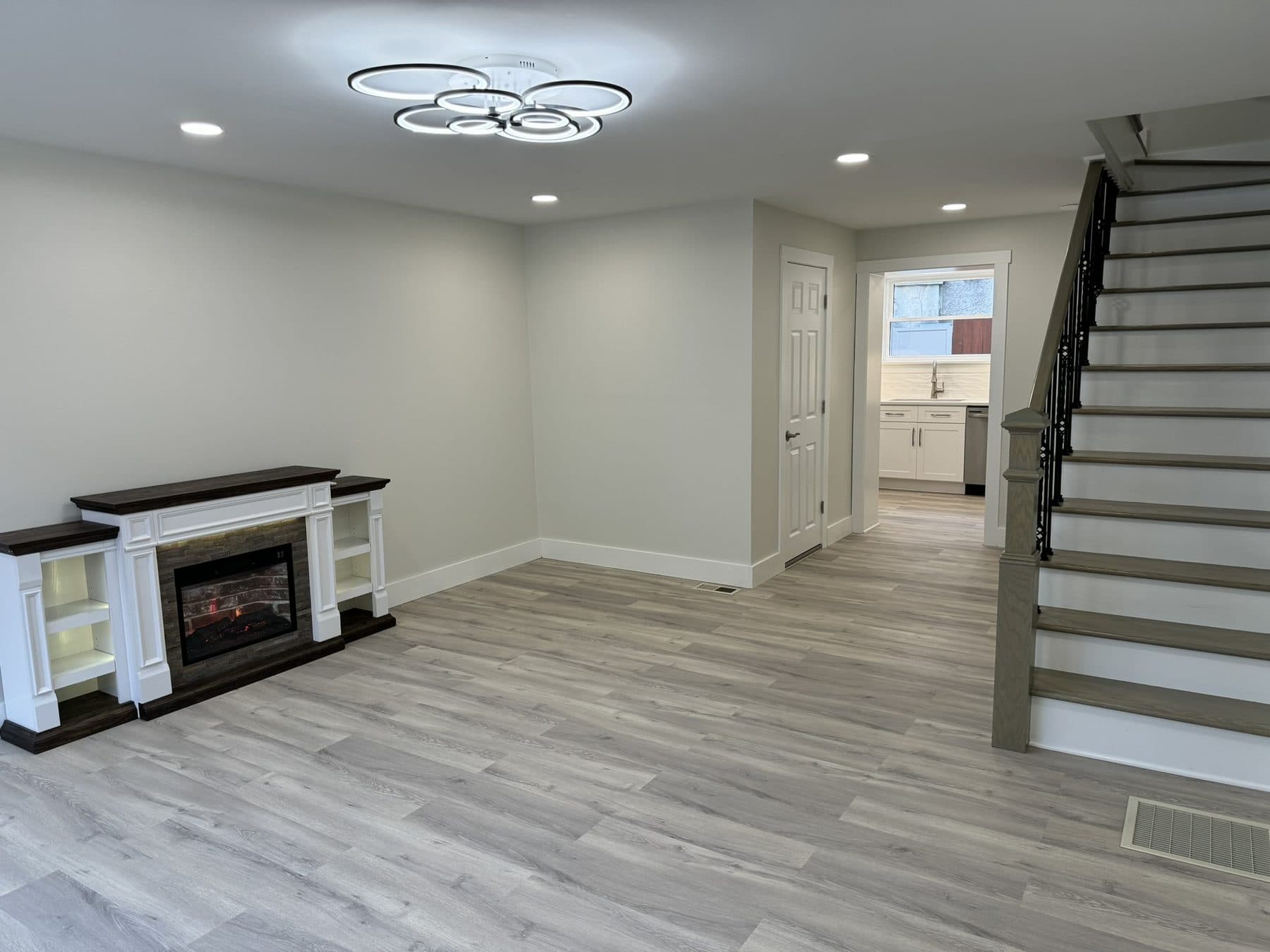 South Philadelphia, PAAug 2025after
Handrail rules
| Rule | Requirement (2021 IRC) |
|---|---|
| When a handrail is required | On at least one side of every flight with four or more risers |
| Height | 34 to 38 inches, measured vertically from the line connecting the tread nosings |
| Continuity | One continuous rail for the full flight, from above the top riser to above the bottom riser |
| Ends | Returned into the wall or ending in a newel post or a safety terminal, so a sleeve cannot catch |
| Space from the wall | At least 1 1/2 inches between the rail and the wall |
| Grip size, round rail | 1 1/4 to 2 inches in diameter |
| Grip size, other shapes | Perimeter of 4 to 6 1/4 inches and no wider than 2 1/4 inches, or a larger profile with a finger recess |
| Strength | Must hold a 200-pound load applied at any point |
The grip rule is the one that catches people out. A decorative 2x6 laid flat on top of balusters looks solid, but a hand cannot wrap around it, so it does not count as a handrail. On a stair like that you either add a graspable rail on the wall side or switch to a profiled oak rail. Standard oak handrail profiles sold at lumber yards are made to pass.
Guard rules
| Rule | Requirement (2021 IRC) |
|---|---|
| When a guard is required | Any open side of a floor, landing, stair or deck that is more than 30 inches above the floor or ground below, measured at any point within 36 inches of the edge |
| Height on landings, lofts and decks | At least 36 inches |
| Height along the stair | At least 34 inches, measured from the nosing line |
| Openings | A 4-inch sphere must not pass through anywhere |
| Openings on the open side of a stair | 4 3/8 inches allowed |
| Triangle under the bottom rail | The triangle between tread, riser and bottom rail may pass a 6-inch sphere, not larger |
| Strength | The top must hold a 200-pound load |
The 4-inch rule exists because a small child's head is about 4 inches across. When we set iron balusters, we space them so the gap is under 4 inches at the widest point. On most stairs that means two balusters per tread.
If you have seen 42 inches quoted online, that is the commercial building code. Houses use 36.
 PennsylvaniaAug 2023after
The stair itself
Railings are only half the inspection. When a staircase is new or rebuilt, the inspector also measures the stair:
- Risers: no taller than 7 3/4 inches.
- Treads: at least 10 inches deep, measured nosing to nosing.
- Consistency: within one flight, the tallest riser and the shortest may differ by no more than 3/8 inch. The same goes for tread depth. This is the rule that trips up DIY stairs, because people notice a short step when they miss it.
- Nosing: on treads less than 11 inches deep, the front edge projects 3/4 to 1 1/4 inches.
- Headroom: 6 feet 8 inches, measured straight up from the nosing line.
- Width: at least 36 inches clear above the handrail height.
What this means for an older house
Many houses in Lebanon, Annville, Myerstown and Lititz have stairs that are steeper and narrower than any of this. The rule of thumb:
- An existing stair you leave alone does not have to be brought up to today's code. It was legal when it was built.
- New balusters or a new handrail on an existing stair should meet today's height and spacing rules. There is no reason to install a new railing that a toddler can slip through, and we will not.
- A rebuilt staircase with new stringers is new construction. It needs a permit, and the inspector applies the current code. In a tight rowhome or farmhouse stairwell where the space physically cannot fit a code stair, the code for existing buildings gives some relief, and the inspector decides how much. We measure before we promise anything.
We ran into exactly this in a South Philadelphia rowhome: the old stair was steeper than code allows, so it came out with the first floor and we built new stringers to current rise and run before anything else in the house.
Do you need a permit for a railing?
Replacing a handrail, balusters or treads on a sound stair is repair work, and in our experience townships in Lebanon and Lancaster County do not ask for a permit. A new staircase, new stringers, or a new guard on a deck or loft does need one, because rise, run, headroom and guard height are inspected. If you are not sure, the township office will tell you in one phone call. When we do the work, we pull the permit.
Common questions people ask
Do I need a railing for three steps? Not by the handrail rule, which starts at four risers. You need a guard only if the open side is more than 30 inches above the floor. A rail on short steps is still a good idea for anyone older or carrying laundry.
Do stairs need a handrail on both sides? No. The IRC requires one side. Wide stairs and stairs used by older people are easier with two, and we often add a wall rail on the second side.
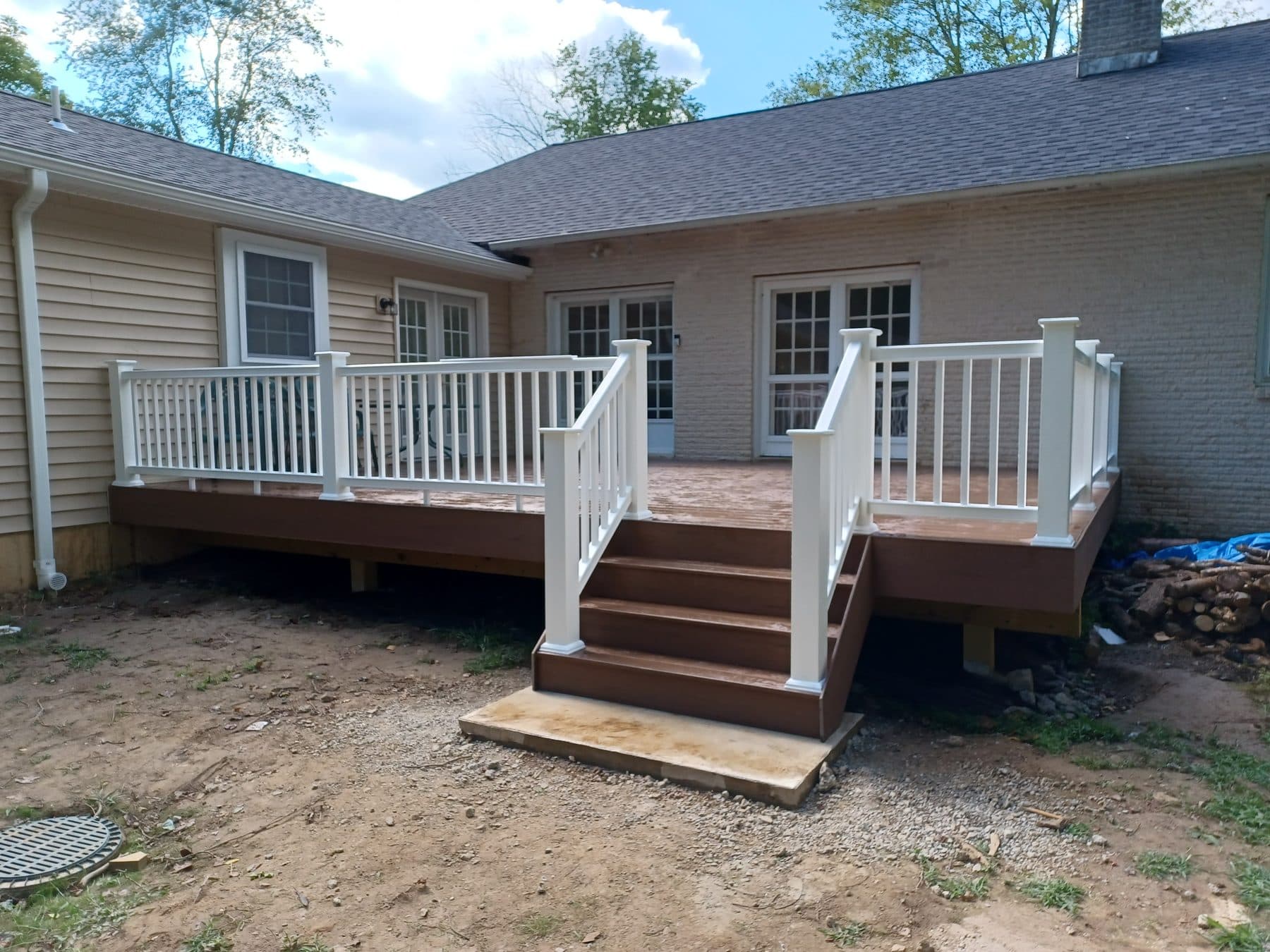
How high should a deck railing be in PA? At least 36 inches if the deck is more than 30 inches above the ground. Deck stairs follow the same 34 to 38 inch handrail rule as indoor stairs.
Is the 4-inch rule measured between balusters or anywhere? Anywhere in the guard: between balusters, under the bottom rail, and around newel posts.
Can I keep my old railing if I sell the house? Yes. Pennsylvania does not require existing stairs to be upgraded at sale. A buyer's home inspector will usually flag a low or loose railing, though, and it is a cheap fix compared with a negotiation.
What a code-compliant railing costs
For a straight staircase in our area, replacing the railing with an oak handrail, oak newel and iron balusters typically runs $1,500 to $4,000. Our staircase remodel cost guide breaks down treads, rebuilds and basement stairs. Prices are typical ranges, not a quote; we price every stair after we see it.
For the full code text, see sections R311.7 and R312 of the 2021 International Residential Code, free to read at codes.iccsafe.org, and the Pennsylvania Department of Labor and Industry's UCC page.
Want a railing that passes the first time?
Our stairs and railings crew rebuilds staircases and installs oak and iron railings in Lebanon County, Lancaster County and Hershey. Send a photo of your stair with the form and we will tell you whether it is a railing job, a retread or a rebuild.